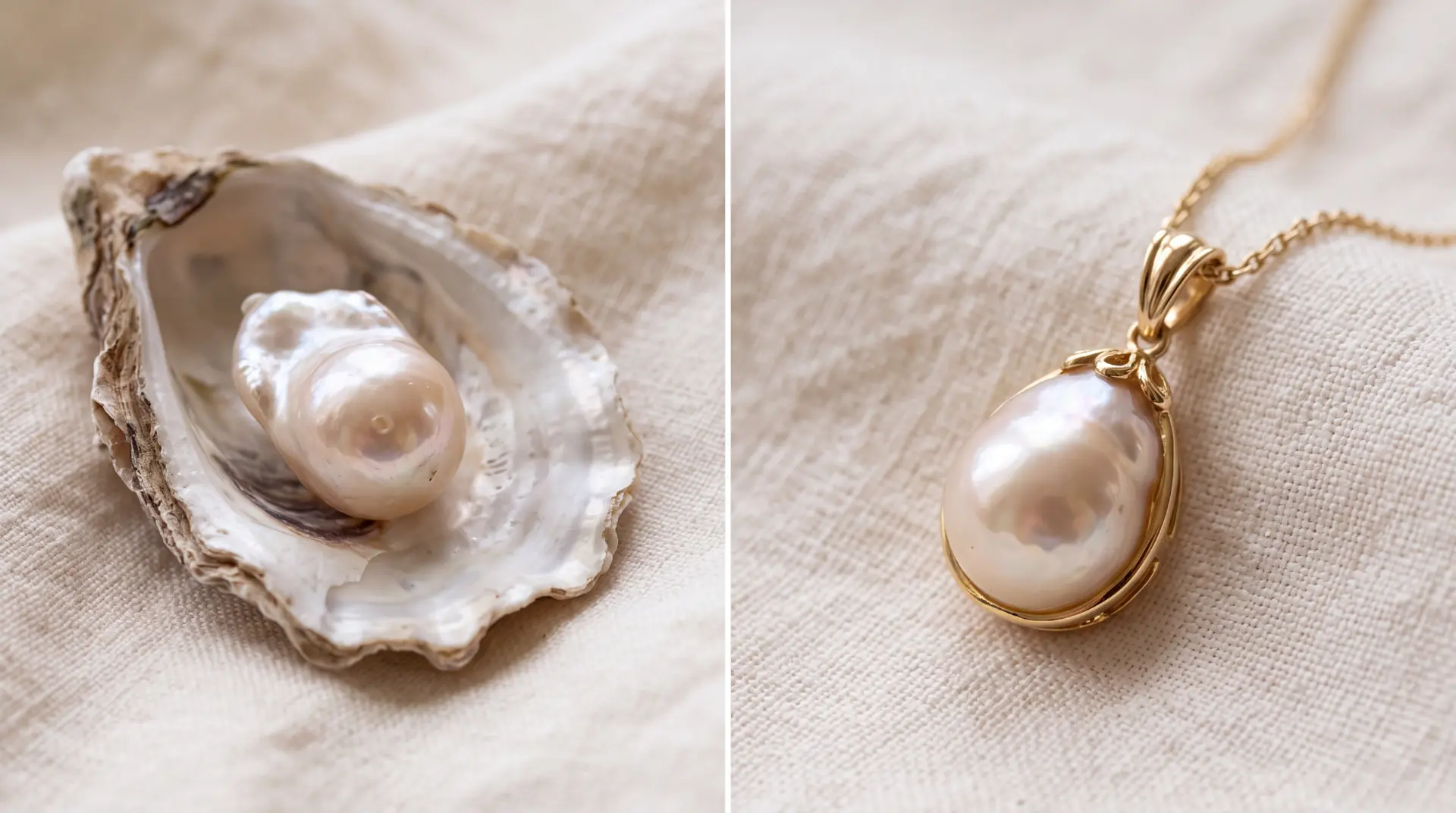
June is the richest month for choice: it has three birthstones — pearl, alexandrite and moonstone. Pearl is the traditional and most-worn June birthstone.
June birthstone jewelry: pearl in white, cream, silver — and color-changing.
Birthstone
Pearl
Also worn
Alexandrite, Moonstone
Color
White, cream, silver — and color-changing
Mineral
Organic (nacre); chrysoberyl; feldspar
Hardness
Pearl 2.5–4 · Alexandrite 8.5 · Moonstone 6–6.5 Mohs
Main sources
Japan, China, French Polynesia, Australia, Sri Lanka, Brazil
What color is the June birthstone, and what does it mean?
Pearl's soft white stands for purity, integrity and quiet wisdom. Alexandrite's green-to-red shift is read as balance and adaptability; moonstone's blue sheen for intuition.
Color is the single biggest driver of value in colored gemstones, and it is also where birthstone symbolism lives. See how every month's color compares in the birthstone color guide.
What does the June birthstone symbolize?
Pearl is the only gem made by a living animal, and it has meant purity, honesty and hard-won wisdom for millennia. Alexandrite, which shifts from green in daylight to red under lamplight, is worn as a stone of adaptability and good fortune. Moonstone's floating blue adularescence links it to intuition and new beginnings.
The history of the June birthstone
Pearls were worn in Persia by 420 BCE and Roman law once restricted them to the ruling classes; Kokichi Mikimoto's cultured pearl, patented in 1896, made them attainable. Alexandrite was found in Russia's Ural Mountains in the 1830s and named for the future Tsar Alexander II — its red-and-green shift matched imperial military colors. Moonstone was the darling of Art Nouveau jewelers such as René Lalique.
For the origin of the twelve-month tradition itself — Aaron's breastplate, Josephus, Polish gem traders and the 1912 American jewelers' list — read the full history of birthstones.
Every June birthstone in detail: where it's found, its powers and its cuts
Modern birthstone · 2.5–4 Mohs
Pearl
Where pearl is found
Cultured in Japan and China (akoya and freshwater), French Polynesia (Tahitian), and Australia, Indonesia and the Philippines (South Sea). Natural pearls come from the Persian Gulf.
Spiritual meaning
Purity, integrity and feminine wisdom; a lunar, tidal stone in most traditions.
Healing powers
Associated with the moon, hormonal balance and emotional smoothing.
Cut styles
Never cut — pearls are graded by shape (round, drop, baroque), luster, nacre thickness and surface. Drilled for strands or half-drilled for studs.
Modern birthstone · 8.5 Mohs
Alexandrite
Where alexandrite is found
Originally the Russian Urals; today Brazil, Sri Lanka, Tanzania and Madagascar.
Spiritual meaning
Adaptability — it changes color with the light, so it is worn for transformation and luck.
Healing powers
Used for regeneration, nervous-system balance and self-esteem.
Cut styles
Round and oval brilliants, cut to show the strongest green-to-red color change rather than maximum weight.
Traditional birthstone · 6–6.5 Mohs
Moonstone
Where moonstone is found
Sri Lanka (the finest blue sheen), India, Madagascar and Myanmar.
Spiritual meaning
Intuition, cycles and new beginnings; a travel-by-night talisman in India.
Healing powers
Used for menstrual and hormonal balance, dreams and emotional clarity.
Cut styles
High-domed cabochons — the dome is what makes the blue adularescence float across the stone.
Spiritual and healing associations are traditional lore, recorded here for cultural interest — they are not medical advice.
How to buy pearl
For pearls, judge luster first: a sharp, mirror-like reflection matters more than perfect roundness. Freshwater cultured pearls are the affordable everyday choice; Akoya for classic round white; Tahitian and South Sea for large exotic colors. Natural alexandrite is rarer than fine ruby — most affordable 'alexandrite' is lab-created and should be sold as such.
Caring for pearl jewelry
Pearls are soft and porous. Put them on last, after perfume and hairspray, and wipe them with a damp cloth after wearing. Never soak a strung pearl necklace — the silk thread rots. Store flat, not hanging.
June birthstone jewelry to look for
Single pearl June birthstone necklace in 18k gold
Pearl and initial personalised pendant
Moonstone bezel necklace for June babies
Alexandrite stacking birthstone ring
A pendant is the most forgiving setting for softer stones, because a necklace takes far fewer knocks than a ring. Bezel settings protect the girdle of the stone and suit everyday wear, which is why a bezel-set june birthstone necklace is the piece most people start with.
If you want the stone on your hand instead, a slim june birthstone ring keeps the setting low enough to survive daily wear, and a personalized birthstone bracelet lets you line up one stone for every family birthday.
June birthstone jewelry: personalized pearl pieces
Shop June birthstone necklaces, rings and bracelets in 18K gold — each one made with the June birthstone and engraved with the name, initial or date you choose. Choose a piece, then pick your finish.
June birthstone: Pearl on film
A short film on pearl, the june birthstone — its color, its meaning and how it is worn.
June has three birthstones: pearl, alexandrite and moonstone. Pearl is the traditional and most widely worn June birthstone.
Why does June have three birthstones?
Pearl and moonstone are the traditional stones. Alexandrite was added to the modern list in 1952, and moonstone was retained as an affordable alternative because fine natural alexandrite is extremely rare.
Is pearl a birthstone?
Yes. Pearl is the primary June birthstone on both the traditional and modern lists — the only birthstone produced by a living creature.
What color is the June birthstone?
Pearls are white, cream, pink, silver, gold or black. Alexandrite changes from bluish-green in daylight to purplish-red under incandescent light. Moonstone is milky white with a blue shimmer.
Can you wear a pearl necklace every day?
You can, with care. Pearls are only 2.5–4 on the Mohs scale, so keep them away from cosmetics, chlorine and abrasive surfaces, and wipe them after each wear.